Animated Gifs

I love when I go to a website and they have an animated gif that helps the view understand more. I don’t mean the “ohh, that is so cute!” use. I mean the sort of animated gif that help make the text more understandable.  This blog about scheduling assignments in Google Classroom is a good example.

giphy (3)


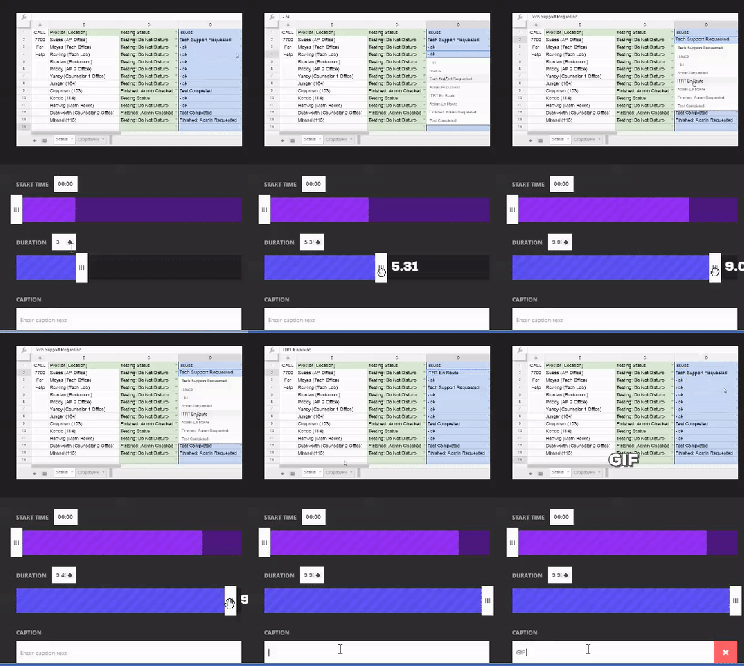
For the animated gif on this post, I did this:

Record Video: I used Snag-It to record a portion of the screen.

Giphy: Uploaded it to Giphy Gif-Maker, adjusted the length, and added a caption.

Downloaded: On the Advance page, I downloaded the gif.


I Am Totally a Pebble

In Virginia, our end of year, high stakes tests are called the Standards of Learning Tests (SOLs). I do not want this post to be complaining about them. Yes they are stressful, and people question their appropriateness at the elementary level. But, as one of my favorite TV show says “The avalanche has already started, it is too late for the pebbles to vote.”

I am totally a pebble.

My goal is to help the stress level. Many schools take over the large spaces and test 50 to 100 students together. Our school decided to reduce the stress on the students by testing them in the room they where they learned the content.  Some students with small group or read aloud accommodations do take the test in a Special Education room or one of the admin’s offices. But, the majority of students end up testing in their usual classroom.

We then needed a way to keep everyone informed.  Who needed help? Who was finished testing?  If I was in a small group, how did I know when I could send my students back to their usual classroom.

When it was everyone in one big room and a few small rooms it was easier to know. Now testing might be spread across 10 different rooms (5 small testing locations and 5 classrooms) it can be more difficult.

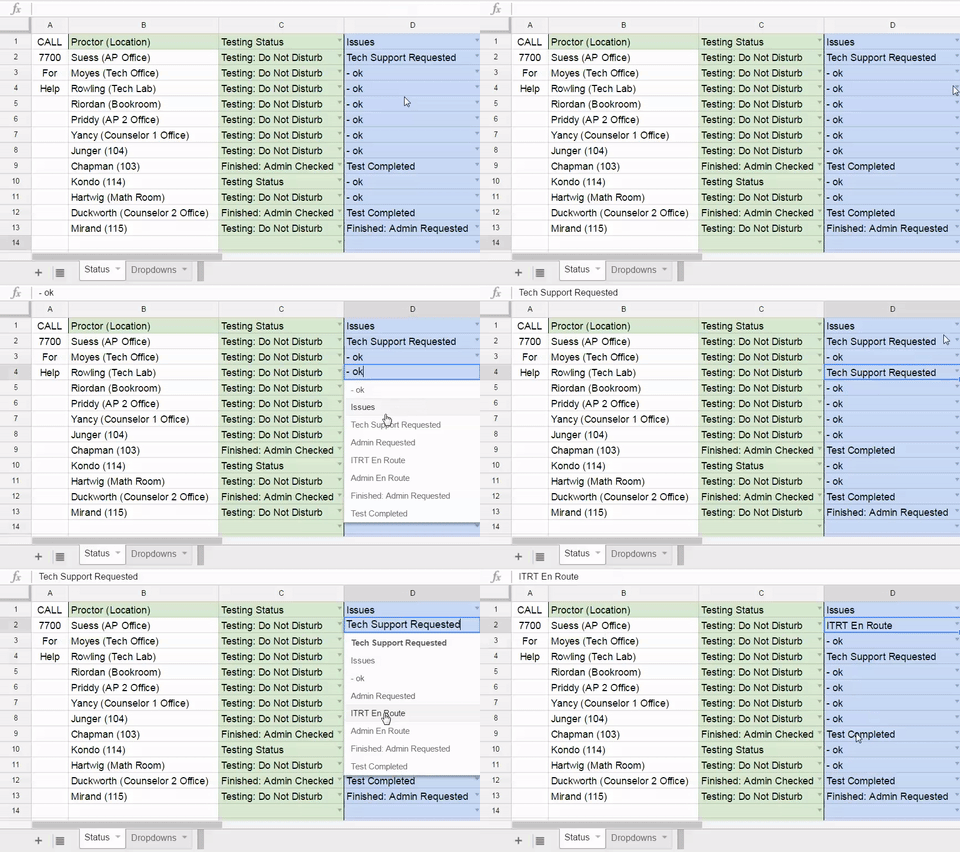
We decided to keep track in Google Apps for Education Sheet.  There are many ways we could do this (Google Apps, Trello, Today’s Meet) But we went with Google Apps because we can . . .

Here is the sheet we used.

giphy (2)

Retreat to the Less Cognitively Demanding

Education Week recently posted this article, Screen Reading Worse for Grasping Big Picture, Research Finds. Sarah Sparks’ article is a good start to the discussion.

There is one part from Geoff F. Kaufman  and Mary Flanagan’s original research that was not mentioned in the Education Week article that I think is important to highlight.*

 Likewise, a growing number of accounts attest to particular information processing habits, such as quick scanning and skimming [4, 24], and expectations, such as immediate gratification, that individuals come to associate with their interactions with digital platforms [18]. The ever-increasing demands of multitasking, divided attention, and information overload that individuals encounter in their use of digital technologies may cause them to “retreat” to the less cognitively demanding lower end of the concrete-abstract continuum. The present work suggests that this tendency may be so well-ingrained that it generalizes to contexts in which those resource demands are not immediately present.

Kaufman  and Flanagan (2016)

I love that phrase “individual encounters in their use of digital technologies may cause them to “retreat” to the less cognitively demanding lower end of the concrete-abstract continuum.”   I skim Twitter and Facebook.  I often catch myself not giving my full focus to Kindle Books. I often retreat to concrete processing.

This is something teachers will have to adjust to and find ways to teach out student to monitor their focus. Teachers call it metacognition, the thinking about their thinking. A quick Google search will give you many places to start.  Benchmark Education has a good overview. Irene C Fountas and Gay Su Pinnell are also important voices on metacognition in education.  It is a topic I’ll be spending more time on.

Kevin

*: I do not mean this post as a critique of Sarah Sparks’ original article. I don’t know if I would I have clicked on the article if the title was “Reading Digital Text Is a Super Complex Issue?”


Articles Mentioned

High-Low Split: Divergent Cognitive Construal Levels Triggered by Digital and Non-Digital Platforms by Geoff F. Kaufman  and Mary Flanagan

Lost in Translation: Comparing the Impact of an Analog and Digital Version of a Public Health Game on Players’ Perceptions, Attitudes, and Cognitions by Geoff F. Kaufman  and Mary Flanagan

Screen Reading Worse for Grasping Big Picture, Research Finds by Sarah D. Sparks

The Austin Split

When I first started to learn how to cook beyond the Foreman Grill and frozen vegetables I decided to blog about it.  I wanted some way to reflect about what I was doing. Looking at other food sites was part of learning, but I didn’t want to put other people’s content and pictures on my blog. It did not feel right, like I was claiming it was my stuff. It always bothered me.

I like how Austin Kleon solves this issue.  He has two different “blogs.”

All of his research and inspiration stuff seems to be on his tumblr. All of the “him” stuff is on his blog.

The Austin Split (as I am not calling it) is nice.  One for his voice, and one for the voices that inspire him.