Power Query

I helped someone out with a project recently. Partway through I regretted volunteering, as it was super tedious. Realizing someone else had probably already figured a smarter way to do to, I found Power Query. Power Query is amazing.

Power Query can automate so much of the grunt work out of your day. I’ve been taking an online class and have been looking for ways to use and practice it.

My current project is using a spreadsheet or organizing my shopping trip. With my ongoing diet (and overall lack of time) my standard lunch/dinner is

  • green salad,
  • vegetable 1,
  • vegetable 2,
  • protein.

I’ve set up an Excel document to help speed up the organizing, purchasing, prepping, and cooking process. Each day I look at it and tweak it to try to make it a little better. As I go I’ll post some of the stuff that I am finding useful.

2021 Kevin Updates

Summer is the time in Ed-Tech where companies announce their “game-changing” updates. Most are just improvements.

Not every change is an improvement and not every improvement changes the game. Changing the color of monopoly money is neither an improvement, nor does it change the game. Turning Connect 4 into Connect 5 would change the game, but not an improvement.

I’ve got a list of my updates for this year. Things I want to change in my mindset and process. I think most are improvements, but I do not yet know how many are game changers. They are set around three themes.

  • Big Rocks
    • Invest my time in the school’s vision. How am I moving the School Improvement and Innovation Plan forward
  • Ship
    • Do not let things flounder, perfect is the enemy
  • Maximize
    • Think 80/20. What will make a difference
  • Mise-en-place
    • Mise-en-place is a culinary phrase which talks about having everything in the right place. It is organizing your space and setting it up for success. Will Kevin in the future happy that Kevin in the past made the easier.
  • Document
    • Leave a trail for future Kevin. Take good notes and reflect upon each day. Blog

Two Roads

I interviewed for a new job. My current position is in Instructional Services. The position I interviewed for is in Information Technology. I love my job, but after this last year, I was interested in looking for a different experience. I do not know which job I will have in July.

So, I’ve been thinking about two different paths. What sort of professional growth would good for my Instructional Services job? How would that be different from my new position in Information Technology.

Instructional Services

I’ve been in the Instructional Services department for around 13 years. I’ve been at a few schools. I’ve mentored a few people. I’ve participated in a few pilot programs. So, what do I want to do with year 14?

  • Highlighting others – There is so much institutional information that get siloed. We have so much to learn from each other and people are willing to share, but often people do not share unless asked. I want to ask. I wanted to create a space where I ask people to share what they are excited about. I thought about first reaching out to people in my position at other schools, but then interviewing teachers as well.
  • Creating Resources – The other part of highlighting others sharing in a way that honors the giver (the person interviewed) and the gift (the knowledge they are sharing). I was thinking about a podcast (yea, I know, who isn’t doing a podcast). It would be about building a space where people could share those great ideas and their ideas could be shared.
  • Focus – When you have been in a position a while you experience a sort of job description creep. Other random things become your job, and stay because of momentum. Why do I do afternoon bus duty? Because originally it was done from the news studio, and the powers that be wanted someone who could troubleshoot the news studio. This is no longer the case, so do I have to be the person in charge of it? Instead, how can I focus on things that fit my mission in the school?

Information Technology

A position in the Information Technology department would be a change. I’ve been in a IT adjacent position. I am not sure what the right professional development would be for next year.

A while back a friend asked for advice in moving to a new school. I had no advice, just my own reflections on how I had screwed up when I made a similar move. Things I told him at the time were

  • Connection – People do not care what you know until they know how much you care. So one goal would be to connect to my new staff. We know listening builds connection. We know engaging in a community builds connection.
  • Reflection – Reflection should be a part of everything we do, job and non-job. But for a new position I think I need to be much more intentional about how I reflect. Maybe a daily reflection? Maybe reflecting with a mentor? I do not have this one figured out as much.
  • Mindset – Jobs have mindsets. The mindset I need for a teacher is different from my Instructional Services job. The IS job would be different from IT. I need to develop that new mindset and move away from the old one.

Wanting to Eat is Not Hunger

I am still on my weight loss journey. I lost over 100 pounds and then my son was hospitalized for 2 months and I spent much of that time self-soothing with food. I came out 40 pounds heavier. I’m trying to lose that weight and a bit more after that.

I’ve been struggling with the idea that me wanting to eat is not hunger. That it is often self-soothing.

I want to approach this the way I approached practicing clarinet. The end goal was to perform the piece. But practice was not about always trying to play the piece perfectly. Practice was about taking apart the music, and my own playing. The practice was about figuring out where the rough spots were, and putting it back together so when you wanted to perform it was the best it could be.

So, I’ve been working on food practices. The current practice is a modified 8:16 intermittent fasting. I start eating at 2:00 p.m. and I stop at 10:00 p.m. The idea is to figure out if I am hungry, or if I am self-soothing. If I start breaking my fast at noon instead of 2:00, I do not worry about it that much.

I’ll start my day, happy as a clam. I won’t even think about food. And then, something stressful happens at work and I’m dying for something to eat. It happens all the time. And I have to tell myself, minutes ago you were not hungry. This is not hunger. This is soothing.

This is my current practice, not necessarily a long term solution. Once I get a better handle on this, the practice might change course.

Technology Isn’t Enough, but you need Enough Technology

“Technology Is Not The Solution!”

I read the above sentiment from educators, or something like it, regularly on Twitter. I understand the intent. We are living through this incredibly difficult time, and the technology will not magically solve all of our problems.

But, every time I see these tweets it leaves me feeling unsettled.

The digital divide is real and it is large. For those with resources, both in terms of hardware and knowledge, to go on about how those resources are not enough feels unseemly.

Technology is not enough, but you need to have enough technology. Most people who tell you that “technology is not the solution” have great technology.

Glycerol Monostearate and Keto Baking

I am not a doctor. If you or someone you love has dietary needs, do not take any advice from some random person on the internet.

My son is on a high fat diet. I start with keto recipes and mixes as a base, and then add fat/butter to read the correct amount of fats for his diet.

But sometimes, I have to add SO much extra fat that the food does not absorb all the fat. For muffins, after baking I would take a muffin out of the tin, and there would be a small pool of liquid fat at the bottom. For flatbread it never seemed to bake correctly. It never felt fully cooked.

My first idea was to use multiple types of fat. I took macadamia nuts (one of the highest fat nuts with the lowest amount of protein. I grinded them down to a smooth paste and added them to the baked goods. It helped, but not enough

I remembered reading about the Chef Step’s Ultimate Chocolate Cake. The folks at Chef Step’s added in glycerol monostearate (GMS). Among other things, GMS acts as an emulsifier. I guessed that if I added GSM into the mix, it might help hold the extra fats I have to add.

The downside is it adds a small amount of carbs. Divided up between the servings it is a pretty small amount.

My first experiment was with Keto Flatbread & Pizza Bread Mix by Keto and Co.

To the mix you add

  • 2 eggs (around 100 grams of eggs, around 9.5 grams of fat)
  • .5 stick of butter (around 57 grams of butter, or 45 grams of fat)

After that I add additional fats for my son’s diet.

  • 20 grams of the macadamia nut paste (around 15 grams of fat)
  • 30 grams of canola oil (30 grams of oil).

To that, I added 5.5 grams of GMS.

The difference was pronounced. The flatbread became fluffy and delicious. No extra fat seeping out of the mix. You would have never guessed the amount of extra fat.

And, my son really enjoyed the bread.

I’ve started adding it to everything I bake for my son. No more pools of fat after I finished.

You also have to pick your battles. Add it to a brownie mix, and it come out much more like a cake. It is not bad, but it no longer reads like a brownie.

Next Steps with the flatbread?

  • Swap out butter for coconut oil
  • Vary the amount of GMS

Future-Proofing

My theme for this year is future-proofing. I want present Kevin to organize and think in a way that future Kevin will be happy out.

I’ve been using Roam Research for part of this. Roam Research’s default view is organized around the date. Roam becomes an index for all the stuff I do in a day.

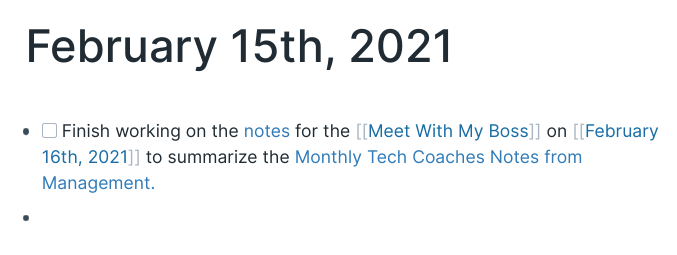
For example, every month I summarize the monthly updates for my job. For today’s date I’ll add a bullet with . . .

  1. The link to the Monthly Tech Coaches meeting from Management
  2. The link to the meeting notes with my boss, where I write the summary
  3. A link to the date in the future when I am going to talk to my boss
  4. A link to the meeting name.

In Roam Research it will look like this.

So tomorrow, when I go, hey, where were those notes again? I can go back to today’s date and find those resources. On the day of the meeting, it will automatically pop-up in Roam Research. If I click on the “Meeting With My Boss” page it will be there. (And, in Google, I have the folders organized so I can find them that way as well).

It is a good first step. Not perfect, but it is getting better.

Coping Strategies

I have note been handling Covid-19 and my son’s new disability very well. I’m using eating as a coping strategy. I’m still stressed. And, I’ve gained 40 pounds since March.

I thought I had already figured out how to overcome this. I realized when I first started my weight loss journey that I had understood that it was a bad coping strategy. I thought that understanding that it WAS a coping strategy allowed me to move past it.

Then 2020 hit. Covid-19 hit. My son’s disability hit. Kindergarten at home hit. And I found out that I was not passed it, that it was still there.

I think part of the problem may be my mindset. I couldn’t just delete the eating, the eating was helping me deal with the situation. The problem was it was also causing other issues, weight gain. I needed to replace it with other strategies.

I found this article about coping strategies and depression. There is a “Multiphasic Inventory for Measuring Coping” questionnaire called Coping Orientations to Problems (COPE) that lists 15 different types of coping mechanisms. I think for me eating became #14, Alcohol and Drug Disengagement. I am using food to relieve unpleasant emotions.

The research goes on to state that people will often choose the least effective coping strategies, one ones that focus on emotions and emotional release. This resonates with me. Before researching this I made a list of possible coping strategies to use, and they were all in the emotions area.

The article highlights 5 coping strategies that are often when professionals treat patients with mood disorders.

  • focus on emotions, (concern about own emotions and tendency to express them);
  • active coping (taking action to try to get rid of or decrease the stressor or its consequences);
  • planning (deliberations how handle the problem);
  • seeking social support for instrumental reasons,  (asking for advice, help or information);
  • restraint coping  (waiting for the right time to do something).

I also need to get a handle on the physiological aspect of all of this. I have been doing a lot of mental disengagement (watching TV / Internet) and not prioritizing sleep. Not getting a good night sleep can mess with stress, hormones, and metabolism. So add sleep to that list.

So I think I need to

  • Start a list of stressors
  • Work on ways to reduce their stress or impact
  • Talk with my wife about how to handle them
  • Ask for help / advice / information on the stressors
  • Figure out the right time to use certain coping strategies
  • Sleep

Under-resourced

On a Friday last month, I reached out to a family who needed help with their webcam. With @UnitedLanguage we overcame the language difference. Microsoft #QuickAssist allowed me to see their screen. After 15 minutes they were ready for first day of school. There was many cheers on all sides.


I read that we should not refer to students as “at-risk.” That term does not focus us toward solutions. Educators should use the phrase “under-resourced.”

If you call a student at-risk, it creates a problem in our thinking. Correspondence bias kicks in and we start thinking of the problems our students face as something core to their nature.

With “under-resourced” you start a conversation getting resources to our students. Instead of thinking of our students as deficient, we think that the do not have the resources they need to flourish.

For many of our students, we need resources layered on top of each other. The family I mentioned at the start of this post, any one resource would not have been enough. A knowledgeable professional (me) was not enough. The family needed an additional resource for translation. And not just translation, they needed translation services available on their schedule.

But that was not enough. In my story at the start of this post, I mentioned that I helped the family on a Friday. That is not the whole story. My first call to them was the day before on Thursday. I called with a translator. We spent almost an hour trying to help the family.

And I failed. I told them they would need to come to school for me to fix it. I told an under-resources family that they needed to spend more of their resources to fix the technology problem. For some families this would not be problem, for this family it would. A 45 minute walk to school. 10 minutes to fix it and 45 minutes back to their house. I was asking a family to commit two hours to solving this problem. I knew it, but I did not know what to do.

And Thursday night I remembered Quick Assist. I called them back Friday afternoon and asked if we could try one more thing. They agreed. We spent five minutes getting Quick Assist working. I spent 10 minutes checking and testing settings. The family giggled as I moved their mouse around from afar. And, we fixed it. And there were many cheers. The family cheered. I cheered. Even the translator cheered.

I did not fix it, we fixed it together. Quick Assist. The United Language Group translator. Me, the technology professional. The family. All these resources working together.

I am so proud of school system for proving these resources to our families.


My apologies to whomever came up with the at-risk v.s. under-resourced idea. I googled around and could not find it, but I am not the originator.

Bitmoji

I keep reading tirades about Bitmojis. And they all make excellent points. There are concerns that they are not inclusive as they should. There are valid privacy questions. Do you need to have additional reasons to give Facebook your data? And, in the end, no students every became better readers because their teacher spent time making a Bitmoji.

Bitmojis are, as are emojis, another tool for communication. Words, pictures, videos, likes on our posts are all methods of communication. And communication is hard.

Interpersonal interactions are about nuance. Human connections are about small details. Small details not always the easiest to send and receive.

A cake with candles is another method of communication. At the right time, it celebrates a moment and builds trust. At the wrong time it can mock the solemnity of the moment.

Don’t swear off birthday cake because someone brought it to a funeral. It is not the cake’s fault.