Changing the Story

I heard Brene Brown once used the phrase “The Story I’m telling myself. It was a way to start a touch conversation with someone. “Something happened, and the story I am telling myself is this.”

I’ve started to use it as a tool to process what I am thinking as well. When I am storming about some email I’ve received I attempt to stop. If I can change the story in my own head, the story I am telling myself, I can re-frame my feelings and responses. I can re-imagine the story as something else.

That time I got an angry email from a friend, the story I told myself was they were mad at me. I could have tried changing the story. Maybe the story was that they were reaching out for a moment of connection, their anger got in the way, and could not find the right words. Maybe my story could be about reaching out to connect with them and building trust between the two of us.

Self-care

Your family needs you. Your job is happy to take any spare time you wish to give. There is so much to do it can be hard to take time for yourself.

The past week has been a struggle. I’ve been taking time away from sleep and self-care to give work and family. Yesterday I crashed. At 2:00 p.m. I emailed my boss that I would not be able to finish a project I was working on until tomorrow. I went to bed and slept for 13 hours.

Then I woke up at 3:00 a.m. My thoughts, in order were

  1. I bet I could finish that project.
  2. I wonder if I could get some work done around the house without waking anyone up.

I do not know what to do for me. Oh, I waste time. I scroll through Reddit or TikTok. But, I am starting to think that time is not for me. I can’t tell you one thing I read on Reddit yesterday. Nothing was so impactful that it made a difference in my life.

So where do I start? I’m removing Reddit and TikTok from my phone. They bring me neither joy nor peace.

What do I do instead? I have not figured it out.

Collaborations

This year is forcing all educators to adjust their practice. The best teachers will reflect and develop a plan that both fits the times and empowers students.

One thing we all need to remember is that this work is a collaboration. None of this is being done in silence. There will be many voices.

Students and teachers. Administrators and parents. Politicians and the community. Everyone will get a say in the final outcome. We all get a voice.

Together, let’s make something we will be proud of.

The Yeahbuts

I woke up with a case of the “yeahbuts.”

I got to school early and my brain went “yeahbut no one is here to let me in”.

Someone sent me an email about an interesting opportunity to help my school. My brain said, “yeahbut, it is going to be a crazy year and maybe this is not the year to take on new things.

Come on Brain, snap out of it! Stop with the yeahbuts. Breathe. Refocus. Take a minute to come up with options and think. You and the community you serve deserve more than the yeahbuts.

Oh, and remember, the wifi works whether you are sitting in the building or right outside of it. So, turn on your laptop, take a seat, enjoy the cool morning air, and start it up.

Let’s to this.

My Food Dysfunction – 2

The last paragraph on this post was . . .

This weight loss journey I’ve been on, at its heart, has to be one of self-understanding. I can lower my calories and lose fat. I can learn more about nutrition. I can exercise and make my body fit. Until I understand more about what is going on underneath the surface there will be no long term changes.

My Food Dysfunction – Notes For Kevin

In March I had a major setback. Before then I was down just around 100 pounds. I have not been that weight since before starting my first teaching job 20 years ago. And then my son got sick. He was in one hospital or another for almost two months. Monday through Friday I was in the hospital with him, 24 hours a day. And with Covid-19 my wife I could not be in the same room together. My parents were quarantined so I could not be there to support. We were renovating, moving, and selling our house

After all this, he is not better. Among other issues, he will be in a wheelchair for the rest of his life.

I relapsed. I went through an overwhelming time, a novel stressful event, a massive withdrawal of my usual support systems. It is not unheard of. Somewhere around 50% of all addicts “fall off the wagon” at some point. There is a similar rate of relapse for those dealing with hypertension.

I ignored my self-care while I was in the the hospital with my son. Some psychologist look at the parts of self-care with the abbreviation HALT. You need to look at yourself to see if you are Hungry, Angry, Lonely, and Tired. Is those things increase, it can be a sign that you are going to be overwhelmed and more susceptible to relapse.

My self care fell apart while I was in this hospital with my son. I ignored all of the problems I was having. I was angry about my son’s diagnoses. I was angry with what that meant for his life, and for mine. I was lonely, all my normal support was taken away. I was constantly tired, as he would need support all hours of the night and day. The only thing I was not was Hungry. I was constantly eating and eating things that were not good for me.

I was self medicating with foods, instead of trying to take a more balanced approach to self care. And I ended up just hurting myself in different way.

So where do I go from here. I thought about doing a daily self care checking. Rating myself on the HALT system to help monitor where I am. For example.

  • Hungry: Not really
  • Angry: Yes, I hurt my foot and knee by tripping over a pair of shoes that were left out.
  • Lonely: Somewhat. I have my wife, but I’ve not seen anyone else.
  • Tired: Yes, very.

So again, I may be in a perfect place to relapse into eating for self-medication. Tonight I need to do something to start to move the needle on all of these.

Facebook Ads

For our winter carnival, I decided to run some Facebook ads. With all the talk in the news about the way Facebook can target an audience, I felt it was something that should be in my skill set.

I focused on two groups. The first set were people in my school’s Facebook group. Around 400 people follow the page. And on a good day, a post will be seen by half that. I can pay Facebook to get the post seen by more. I put 10 dollars into this ad for five days.

You can also target by distance. I could select a radius around the building to choose my audience. I used a three-mile radius. Again, I did 10 dollars over five days.

For the add, I used the same infographic in both ads. It was from our PTA. It has all the who, what, where, and when of the event with our logo.

Results-wise, the second had more impact. For ten dollars, an additional dozen people showed up at the event. If even half purchased something, that probably would recoup the cost.

For the next steps, I would try three types of experiments. First, increase the spend on the distance-based ad. That seems to get the most return on investment.

Second, try a more engaging set of pictures for the ad. Maybe something better than an infographic. Our PTA’s next event will probably be a restaurant night fundraiser. I thought photos of our school mascot going to the restaurant would be cute.

Third, look into language targeting, specifically Spanish. Half of our schools’ students have Spanish as a home language. For flyers, we do translations; we should for Facebook as well.

Plans for Outreach

I am restructuring how I handle parent outreach. The big vision is, have the website be the central hub and try to meet parents where they are. This is very influenced and inspired by Gary Vaynerchuk.

Website: The homepage is the digital hub for the school. There are three types of content that we add weekly.

  1. Calendar Events:  Any school-wide events, such as the winter carnival, band concerts, and SCA events are on the website. These are not classroom specific (upcoming field trips or tests); these events are ones that affect parents or are open to the broader community.
  2. Announcements: If there is an announcement from the school or something that would affect parents, it is on the site. 
  3. Blog Posts: The website is also our newspaper of record. Every week we blog the noteworthy events from our school.

Then we move from there out to reach parents on other platforms. 

Email Newsletter: 

The content of the newsletter is similar but structured differently. 

  1. Blog Posts: At the top of the newsletter is an image from the weekly blog post with a link for the parents can learn more if they want.
  2. Calendar Updates: Next is a calendar. We highlight important dates for the next six weeks. Each one has a link to our school website or the main county website.
  3. Announcements: We wrap up with upcoming announcements. I post each one for two weeks. Often the second posting a shortened version of the first, with a link to the website that has the full text.

Social Media (Facebook/Twitter)

Again, social has the same basic structure, plus one.

  1. The Social Stream: Video and pictures from the school day.
  2. Blog Posts: We advertise new blog posts on or social media. Each blog post gets advertised two or three times after the newsletter comes out.
  3. Calendar Updates: Before an event happens, we post a few reminders to social media. I am still working on the schedule — the day before, there is always a reminder post. Additionally, we have been experimenting on when else to post. How many other reminders are appropriate? I am not sure. Maybe two days before and a week earlier? I am not sure the correct answer for this.
  4. Announcements: A shortened version of the announcements make their way to Facebook/Twitter. I am still not sure how these should be a part of the outreach process. They are important. But how often will a parent click to read 500 words on our Family Life Education announcement?

That is what we are up to now. There are a few big holes in our digital outreach strategy.

  • Everything is in English
  • There is no text aspect
  • Nothing on Instagram, YouTube, TikTok, . . .
  • Making social media posts engaging vs the time I have to make them engaging
  • The process of how announcements come to my attention can be inconsistent

These holes need more discussion, but that is for another day.

Managing Time, Part 2

Part of getting a better sense of how I use my time thinking about how I categorize my time.

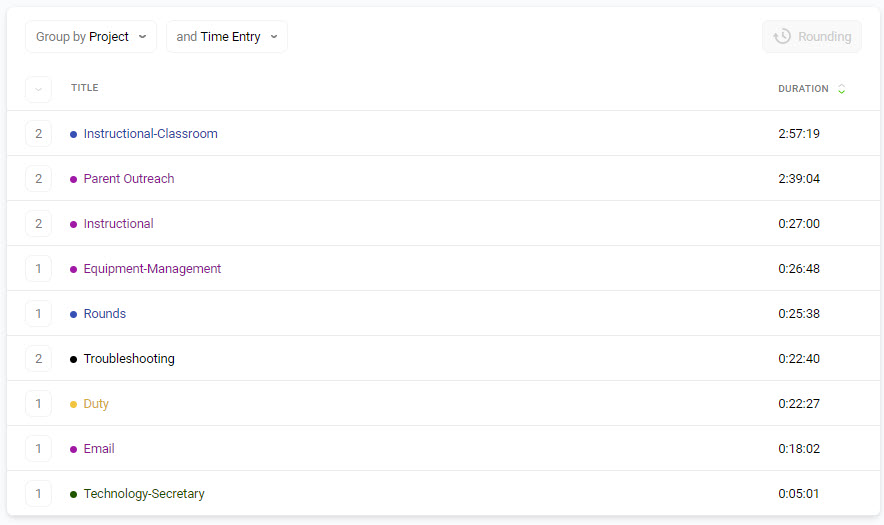
Initially I used the Virginia guidelines on for how ITRTs use their time. I then added a few of my own categories. Over the past few weeks I’ve added two more.

  • Technical-Secretary: For example, one week I spent almost an hour updating room use calendars in Outlook.
  • Equipment-Management: Today I’ve spent about 25 minutes setting up computers for new students (printing out labels, assigning them in the database, that sort of thing)

I’ve also split the instructional category into two parts. It made looking through the data easier.

  • Instructional: Working and planning with teachers, researching new technology, designing new processes and programs for our school (70% or 27 hours a week)
  • Instructional-Classroom: Modeling and co-teaching in the classroom setting.

Yesterday my day looked like this.

Picture of time breakdown of my day.

Time Spend On Email

I’ve been tracking my time over the past few weeks and one trend I see is that I spend way to much time on email.

So I searched around on how to get a handle and I saw a few trends.

David Allen of GTD fame suggests a 4 prong approach. Delete. File what you can file. Anything you can do in just 2 minutes, just do it. If it is a longer project, get out of your email and into a system of managing your todo lists.

Tim Ferriss suggests limiting your mail checking to twice a day.

So combining these together I am now.

  1. Checking my email at 7:30 when I arrive. I process my email until anything actionable is in my todo system in Airtable. Anything that I need to keep a record of goes into OneNote. I respond to whatever needs responding. I only leave emails in my inbox that I am expecting a response from that day.
  2. I then close Outlook and look at my Todo system.
  3. Around 12:00, while I am eating lunch I reopen Outlook and reprocess my email.

And that is sort of it. I’ll also sometimes go in at the end of the day as well.

And I am not perfect, I still sneak peeks sometime. But it does not seems to be a good strategy, so I am trying to limit it.

My Food Dysfunction

Thus is not about school, tech, or my job. This is thoughts about food.

I have a dysfunctional relationship with food. The outward display of that dysfunction is that I’ve been overweight most of my life and obese for most of my adult life. But that stems from an internal dysfunction around food. That dysfunction has many levels.

One level is as an American. 40% of Adults in America are obese. If you include overweight Americans in that, it jumps up to around 60-70% are overweight or obese. Being fat is the default position in America. That is a pretty clear indication that there is a systemic, nationwide issue with fat in America. There are issues of culture and policy that tip the scales of American’s collective levels of fat. Other countries do not have the same issues around obesity, though other countries may have other national problem. That national dysfunction would be enough to ensure me being overweight and obese.

However, this is about me. I have my own issues. I use food to gloss over a number of emotional issues.

I sooth my emotions through food. On bad days my brain wants to sooth itself with food. I had a bad day at work and I instinctively wanted to buy a milkshake. I caught myself and realized what I was doing. But my next choice was to think about buying pizza instead. It is something I am constantly working on.

I’ve gotten better at it, but I keep learning about additional layers. On bad days I don’t stop by Starbucks and drink and eat 800 calories of self -soothing, but I’ll stop by the grocery store to get a 12 pack of diet soda. Calorie-wise it is a better choice (though health-wise it may not be), but I realize the intent is the same. I’m still soothing my emotions through food.

There is more, but this is the one that is most clear in my head. I’m still working on the rest.

This weight loss journey I’ve been on, at its heart, has to be one of self-understanding. I can lower my calories and lose fat. I can learn more about nutrition. I can exercise and make my body fit. Until I understand more about what is going on underneath the surface there will be no long term changes.